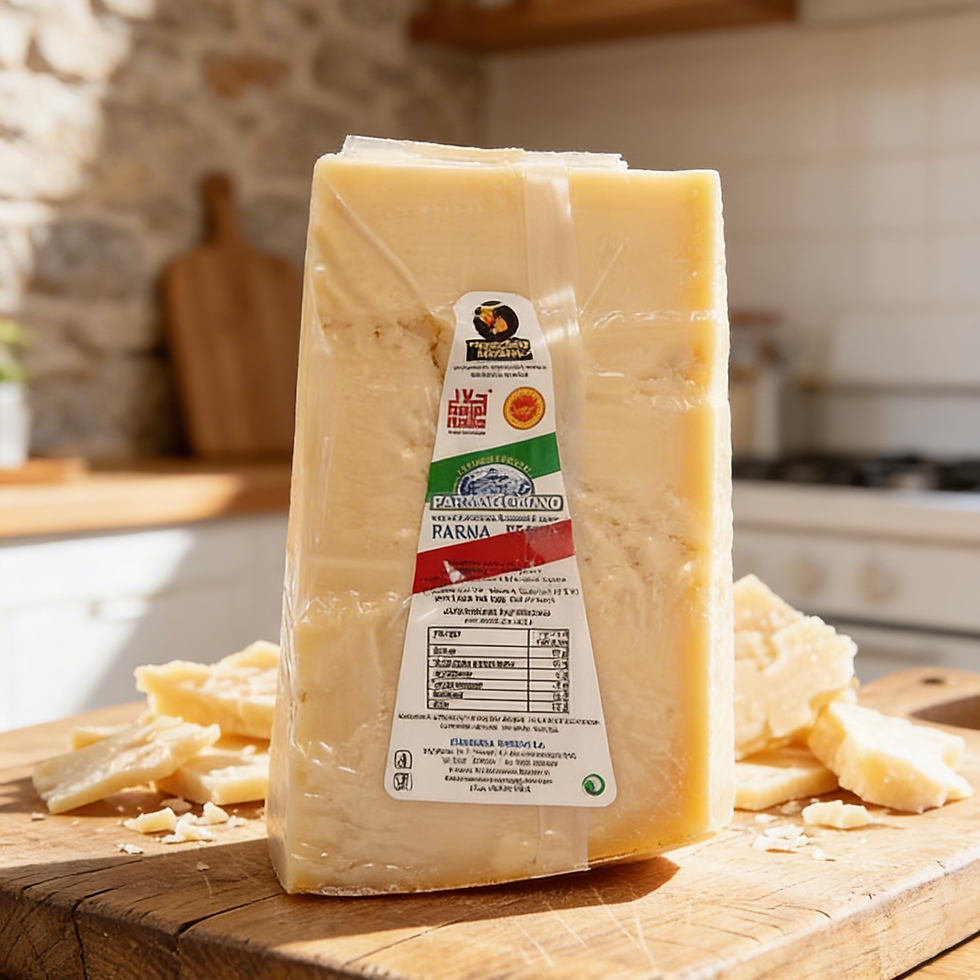
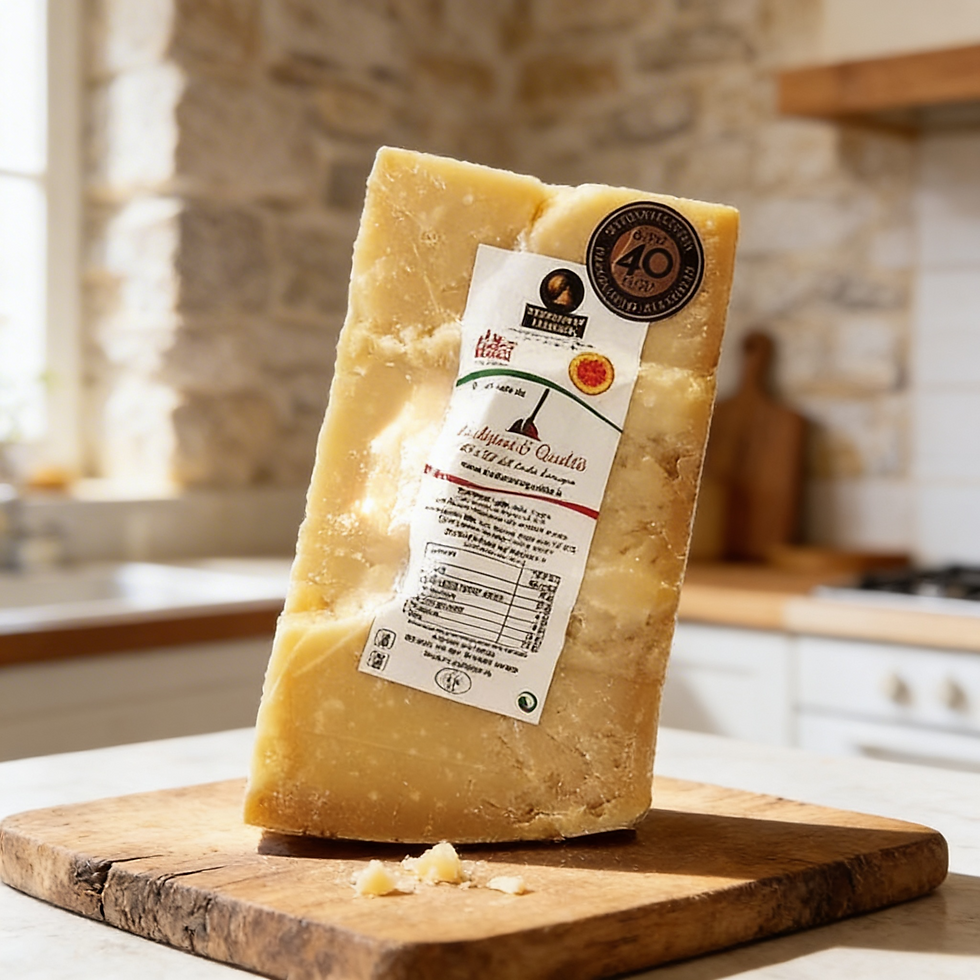
Selection of Grana Padano DOP - 15 months and Reserve

 Minimum maturation: 15 months and 20 months

 Product Weight: 1kg+1kg = 2kg

 Producer: Cascina Ca' dell'Ora

 Vacuum-packed and ready-to-eat product
Selection of Grana Padano DOP - 15 months and Reserve
Grana Padano DOP is a hard, cooked, and slowly ripened cheese made with cow's milk from cows milked no more than twice a day and fed on green or preserved fodder from the production area. This is the "Riserva" version and is aged for a minimum of 20 months.
The production and grating area of Grana Padano PDO includes the provinces of Alessandria, Asti, Biella, Cuneo, Novara, Turin, Verbania, and Vercelli in the Piedmont region. In the Lombardy region, it includes the provinces of Bergamo, Brescia, Como, Cremona, Lecco, Lodi, Mantua to the left of the Po River, Milan, Monza-Brianza, Pavia, Sondrio, and Varese. The autonomous province of Trento. In the Veneto region, it includes the provinces of Padua, Rovigo, Treviso, Venice, Verona, and Vicenza. In the Emilia-Romagna region, it includes the provinces of Bologna to the right of the Rhine River, Ferrara, Forlì-Cesena, Piacenza, Ravenna, and Rimini. Furthermore, it includes the entire administrative territory of the municipalities of Anterivo, Lauregno, Proves, Senale-San Felice, and Trodena in the autonomous province of Bolzano.
The milk is partially skimmed by natural skimming at a temperature between 8 and 20°C and placed in copper or copper-lined vats, with their characteristic inverted bell shape. Natural whey starter is added to the milk in the vat, which is then heated to 31-33°C and calf rennet is added for coagulation. The curd is then broken with a cheese whisk and cooked under stirring until it reaches a maximum temperature of 56°C. To reduce the risk of late swelling resulting from possible contamination of the milk by Clostridium tyrobutyricum, the addition of lysozyme, a natural enzyme extracted from egg white, is permitted. The curd mass settles to the bottom of the vat and is left to rest for up to 70 minutes to firm up and purge the whey. Finally, the workers, using a wooden shovel and a cloth (schiavino), lift the cheese into the boiler and cut it into two equal pieces, known as "twin cheeses." Each piece is wrapped in a linen cloth, removed from the boiler, and placed on the sieve. It is then placed in special moulds for at least 48 hours, which imprint the marks of origin, and then brined for 14 to 30 days. After drying, which can take place in a room known as a hot chamber or a stewing room, the maturing process begins, lasting from a minimum of 9 to over 20 months. After eight months, the cheeses are subjected to an inspection process, which involves branding them, or, if the product does not meet the specifications, the marks of origin imprinted on the moulds are removed by "netting." Grana Padano PDO wheels are cold-stamped with the mark of origin and a series of dotted rhomboidal lozenges containing the words "GRANA" and "PADANO." These rhomboidal lozenges are repeated throughout the wheel, except for a space reserved for the GRANA PADANO branding. In the center is a four-leaf clover, bearing the abbreviation of the province where the cheese is located, the registration number of the producing dairy, and the wording "PDO." To the bottom left of the four-leaf clover is the CE stamp, identifying the production facility, while to the right is the month and year of production.
The origins of Grana Padano PDO date back to the year 1000, when Cistercian monks, to meet the need to preserve the excess milk produced in the area, experimented with the production of a hard, long-lasting cheese, " caseus vetus ," later called grana. By the end of the 11th century, this product was already well-established, with a veritable commercial network.
Characteristics
Grana Padano PDO has a cylindrical shape, a hard, thick, and smooth rind, and a golden yellow color. The paste is finely grained, straw-yellow in color, with barely visible holes. The aroma is fragrant with hints of butter and hay, while the flavor is rich, complex, and generously savory.
Pairings
Grana Padano Riserva pairs perfectly with chestnut honey, fig jam, or pear jam, creating a balance between sweetness and savory flavors. Dried fruits like walnuts and almonds enhance its structure, while an Amarone della Valpolicella or Barolo enhances its intensity. Excellent with Parma ham and culatello, it's best enjoyed with whole-grain bread or artisanal breadsticks. Perfect for enriching risottos, stuffed pastas, or meat carpaccio, it's a refined pairing with Traditional Balsamic Vinegar of Modena, which enhances its aroma.
Milk, salt, rennet, preservative: Lysozyme