
Salama da Sugo PGI (raw)
Product weight: 1.200 kg
Minimum seasoning: 180 days
The product will arrive vacuum-packed ready to be cooked
IMPORTANT: The weight of cured meats being artisanal can never be accurate to detail. Should there be any weight differences, we will compensate for them by varying the quantities of other products in the cart, but there will never be any price variations.
Salama da Sugo PGI - Raw "1.200 kg
Salama da Sugo PGI is a charcuterie product made from a mixture of flavoured pork meat and stuffed into the pig's natural bladder. After drying and seasoning, it is produced in two types: Raw and Cooked.
The production area of Salama da Sugo PGI includes the territory of the province of Ferrara with the exclusion of the municipalities of Goro, Codigoro, Lagosanto and Comacchio, in the Emilia-Romagna region.
The raw material for the production of Salama da Sugo PGI must come from pigs that are more than nine months old at slaughter. Selected cuts of meat must be used, such as: goletta, capocollo, pancetta, shoulder, tongue and liver, composed in established percentages, with the optional addition of chopped underbelly. The meat is flavoured with selected red wine aged for no more than 18 months. In addition to black pepper and coarse sea salt, certain spices (cinnamon, nutmeg, cloves) may be used, while brandy, grappa or rum may be used individually as partial substitutes for red wine. The cuts are processed manually with the aid of a knife, to allow for accurate trimming. The minced mixture - weighing between 1,200 and 2,000 g - is placed inside the pig bladder. The bagging operations are carried out manually to guarantee the integrity of the bladder, which is tied up with string. This is followed by drying and curing operations. In the Cotta (cooked) type, after the curing period, the Salama da Sugo PGI is washed with hot water to remove traces of surface mould that form naturally during curing. The product is then packaged with or without bladder, whole or in slices of varying weights, in a first flexible casing that is resistant to sterilisation temperatures and sealed to contain the liquid that escapes during cooking. This is followed by heat treatment in an autoclave at a temperature of between 115 and 121°C.
The origins of Salama da Sugo PGI can be traced back to the Renaissance period and are linked to the court of the Dukes of Este, lords of Ferrara from the 12th to the 17th century, who gave a strong impulse to convivial entertainment. In 1722, a playful poem entitled 'La Salameide' was published, in which the author Antonio Frizzi explains the etymology of the name salama in a fantastic key and honours its Ferrara origins.
Characteristics
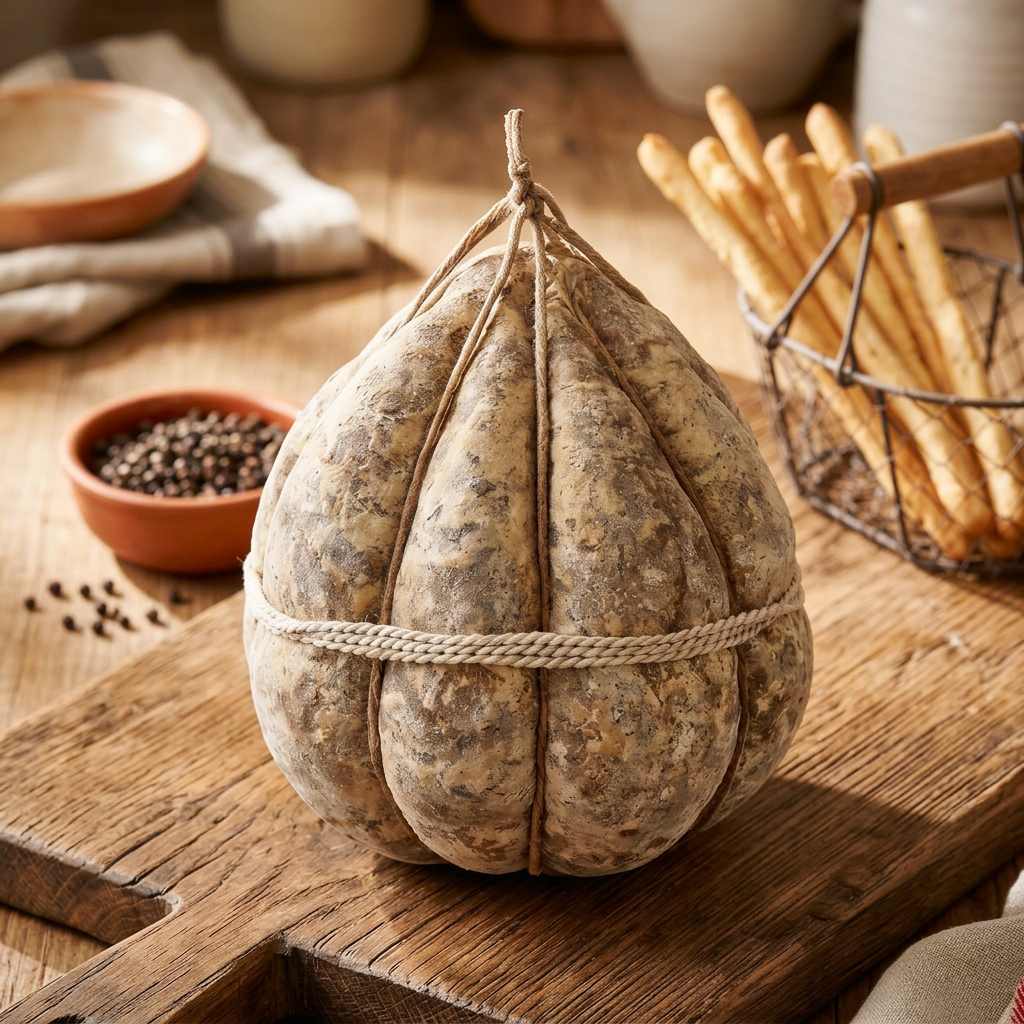
Salama da Sugo PGI has a characteristic spherical 'melon-like' shape with division into 6/8 segments and a median choker, weighing between 700 and 1,400 grams at the end of the maturing period. The outer surface is irregular, possibly covered with traces of mould that occur naturally during the maturing process. The consistency is soft and compact. The aroma is intense and fragrant, the flavour is full with aromatic residues.
Pairings
Salama da Sugo PGI must be eaten after cooking, both in the raw and cooked types, only the preparation method and time change. It must be served hot, either by removing the top and extracting the meat with a spoon, or by removing the skin entirely and placing it whole, on a chopping board, preferably a hollow one, to more easily collect the sauce that comes out during cutting. It is served with mashed potatoes, which can be seasoned with the red sauce that comes out when cutting. Try it also with lentils or borlotti and cannellini beans.
Pork, wine, pork fat, pork tongue, pork liver, salt, dextrose, spices
antioxidant (E301)
preservative (E250