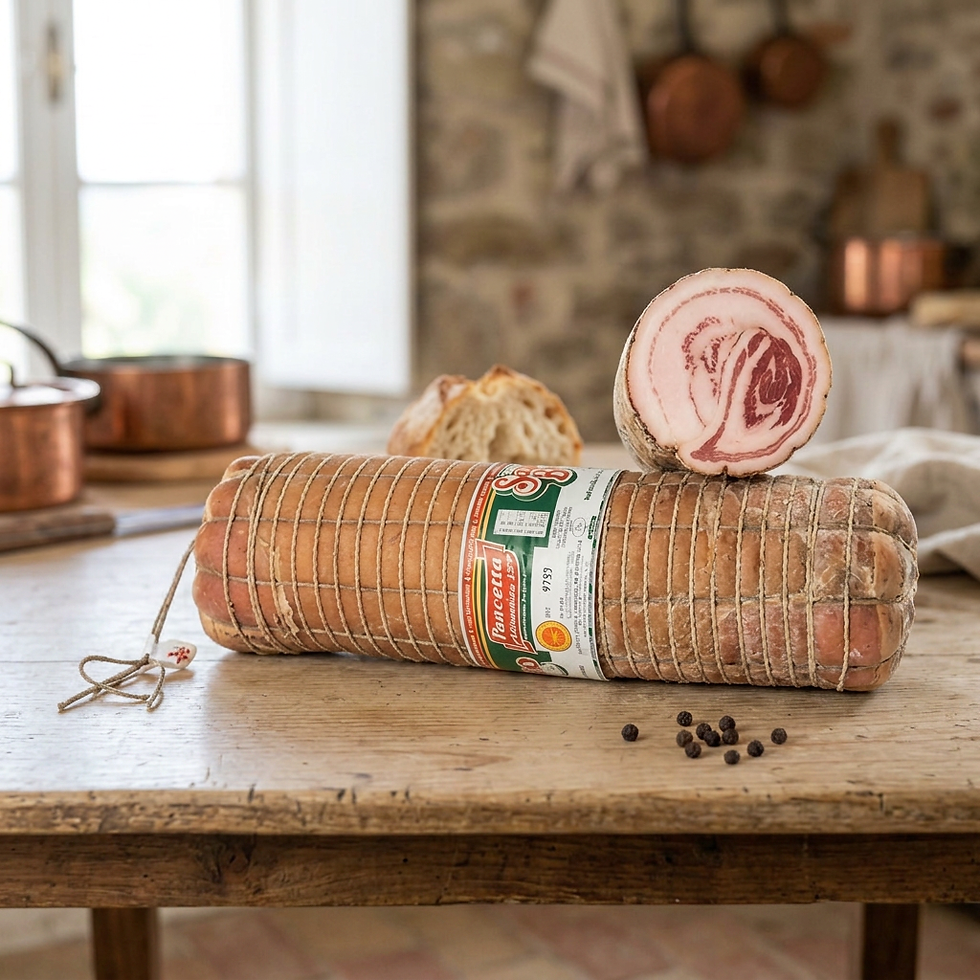
Coppa di Parma PGI
Weight: 0,950 kg
Minimum ripening: 120-150 days
The product will arrive vacuum and ready to cut
IMPORTANT: The weight of the sausages being artiginali can never be accurate to detail. If there are differences in weight, we will compensate for small weight differences by varying the quantities of other products in the cart, but there will never be price changes.
Coppa di Parma PGI - Slice "0,950 kg"
Coppa di Parma PGI is a delicatessen product obtained from the muscular portion of the neck of pigs belonging to pure or derived breeds, Large White, Landrace and Duroc Italiana or other breeds deemed compatible with the Italian heavy pig.
The production area of the Parma Cup PGI affects the entire provinces of Parma, Modena, Reggio Emilia, Mantua, Pavia as well as the municipalities of the Po belt that are part of the administrative territory of the provinces of Lodi and Cremona and the municipality of San Colombano al Lambro in the province of Milan, in the regions of Emilia-Romagna and Lombardy.
The muscle fractions are carefully cleaned, isolated and trimmed. It is then followed by manual or mechanical salting by churning, a kind of massage of the meat based on salt, natural aromas, pepper and/or any other spices, which can also be applied in successive stages during the period in which the cup is left inside the cold storage rooms (6-10 days). After a further period of rest (at least five days), the filling is continued. The product intended for sale in whole form or in slices is bagged in natural casing; the one marketed after slicing is stuffed into reconstituted natural casing by assembling several anatomical pieces in series. Once stuffed, it is tied with twine in order to form meshes. Stewing and drying take place in the same rooms, but at different times. For maturing, temperatures of about 12-16 ºC and relative humidity of 70-87% are required. The minimum duration of the process is 60 days from the start of processing for cups from 2 to 2.6 kg and 90 days for cups weighing more than 2.6 kg.
The references and quotations that attest to the consumption of the Cup of Parma are numerous and are found as early as the seventeenth century; we can cite for example the documents in which we speak of the product using the term "bondiola" or "salami invested", or stuffed. In the memories of some travellers of the eighteenth century it is already mentioned as a typical gastronomic place. An inventory of 1723 shows that, in order to become part of the Lardaroli guild, it was necessary to possess a certain number of salami and bondiole, confirming the value of the product. At the same time the contracts for the supply of food of the Royal Kitchens date back, in which the request for bondiole usually appears, as particularly appreciated also at the court of the Duke Don Ferdinando Bourbon. Since 1800 there has also been evidence of the increase in the sale of the Parma Cup in the markets of the area.
Characteristics
The Coppa di Parma PGI has a cylindrical shape, with dimensions ranging from 25 to 40 cm in length, and a weight of not less than 1.3 kg. When cut, the slice is medium compact, not greasy, red in the lean part and pink in the fat part. The scent is intense, persistent and really rich in aromas and flavors. The palate has a delicate, enveloping and with an adequate degree of flavor. Overall, it is tastier than the Coppa Piacentina PDO.
Pairings
It is proposed as an appetizer or main course, combining it with cold cuts and cheeses of the Emilian tradition. Excellent with the vegetable gardener, with the melon Mantua PGI or pear of Romagna PGI, making a contrast between sweet and salty.
Pork, salt, spices.
Preservative: E252