Salame di Cremona PGI
Product weight: 0.570 kg
Minimum seasoning: 40 days
The product arrives wrapped and ready to be sliced
IMPORTANT: The weight of sausages being artisanal can never be accurate to detail. Should there be any weight differences, we will compensate for them by varying the quantities of other products in the cart, but there will never be any price variations.
Salame di Cremona PGI
Salame Cremona PGI is a cured, coarse-grained sausage product made from the processing of lean and fatty meat of Italian heavy pigs of the Italian Large White, Italian Landrace and Italian Duroc breeds.
The production area of Salame Cremona PGI includes the regions of Lombardy, Emilia-Romagna, Piedmont and Veneto.
The pork to be used for mincing is that obtained from the carcass muscle and the striated and adipose muscle fractions, carefully trimmed and then minced in a mincer using moulds with 6 mm holes. To the mince, natural flavourings such as salt, spices, peppercorns or coarse pieces and crushed garlic are added. Kneading is carried out in vacuum or atmospheric pressure machines for a prolonged time. The mixture is then stuffed into natural pork, beef, horse or sheep casings with an initial diameter of not less than 65 mm. Tying is done with twine, either manually or mechanically. The product may be stored for a maximum of one day at a temperature of between 2 and 10 °C. Drying takes place hot at a temperature of between 15 and 25 °C to allow rapid dehydration of the surface fractions in the first few days of treatment. Maturation takes place in rooms with sufficient air exchange and temperatures between 11 and 16 °C for a period of no less than five weeks and varies depending on the initial casing size.
The origins of Salame Cremona PGI date back to Roman times. Numerous documents often refer to the buying and selling of pigs sold by farmers who held half-earnings contracts with the owners of the animals (soccida). For certain information on the diffusion of salami and even its certain notoriety, we must go back to a series of Renaissance documents in the Litterarum and Fragmentorum of the Cremona State Archives. These documents reveal the presence and, above all, the importance of the salami product. The birth of salami in the Cremona area is also ascertained by the notary Ludovico Cavitelli in his 'Annales' (Cremona, 1588), as well as by the list of foods consumed every day in the Cremona convents: if salami was a staple food in the diet of the convents, it can be assumed that it was also in that of the population.
Characteristics
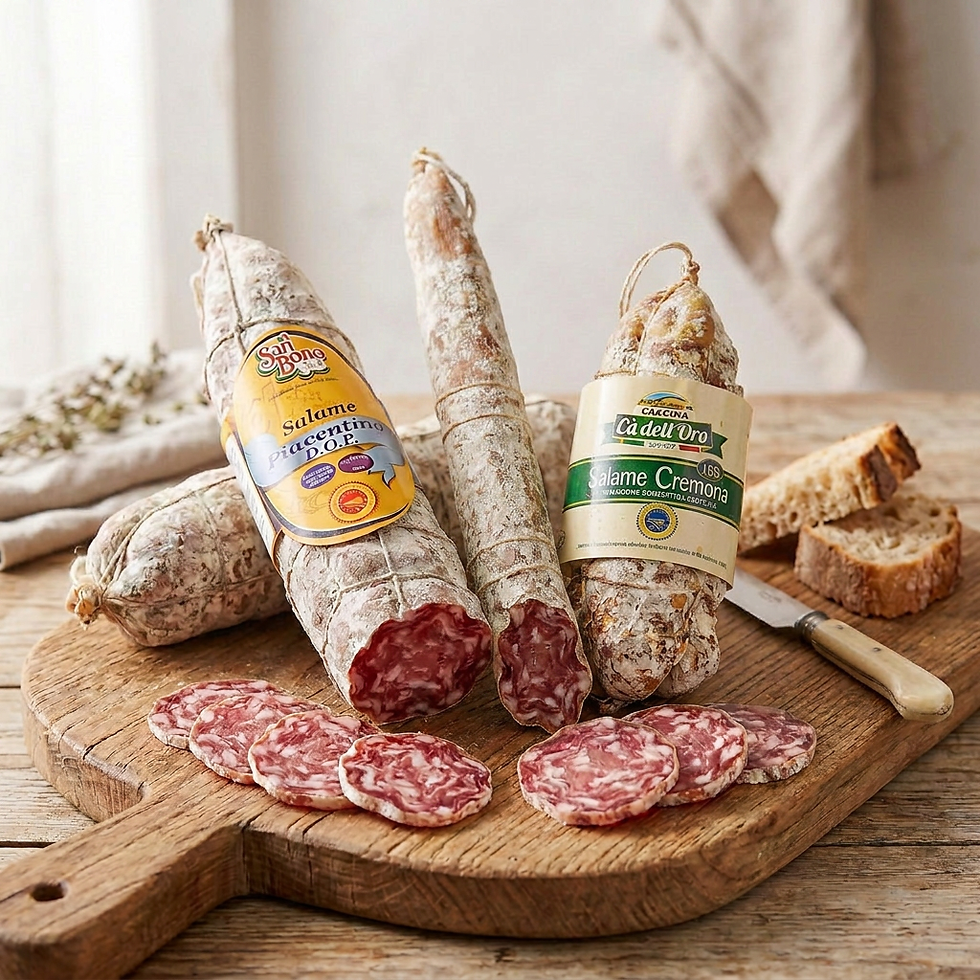
When cut, the slices are compact and homogenous, with a deep red colour that gradually fades into the white of the fatty parts. To the nose it has a typical, spicy aroma, while the taste is rich, full and complex with aromas and flavours.
Pairings
It goes very well with cheeses and other local cured meats. It can be eaten on its own, as a snack, main course or diced to create tasty aperitifs. An alternative and tasty recipe proposes this salami served with figs or pears; being soft, when chewing, there is no difference between the consistency of the salami and that of the fruit, resulting in a pleasant sensation for the palate. For the same reason, it should be tried with brioche.
Pork, salt, dextrose, garlic, antioxidant E300, spices, preservatives E252, E250.