


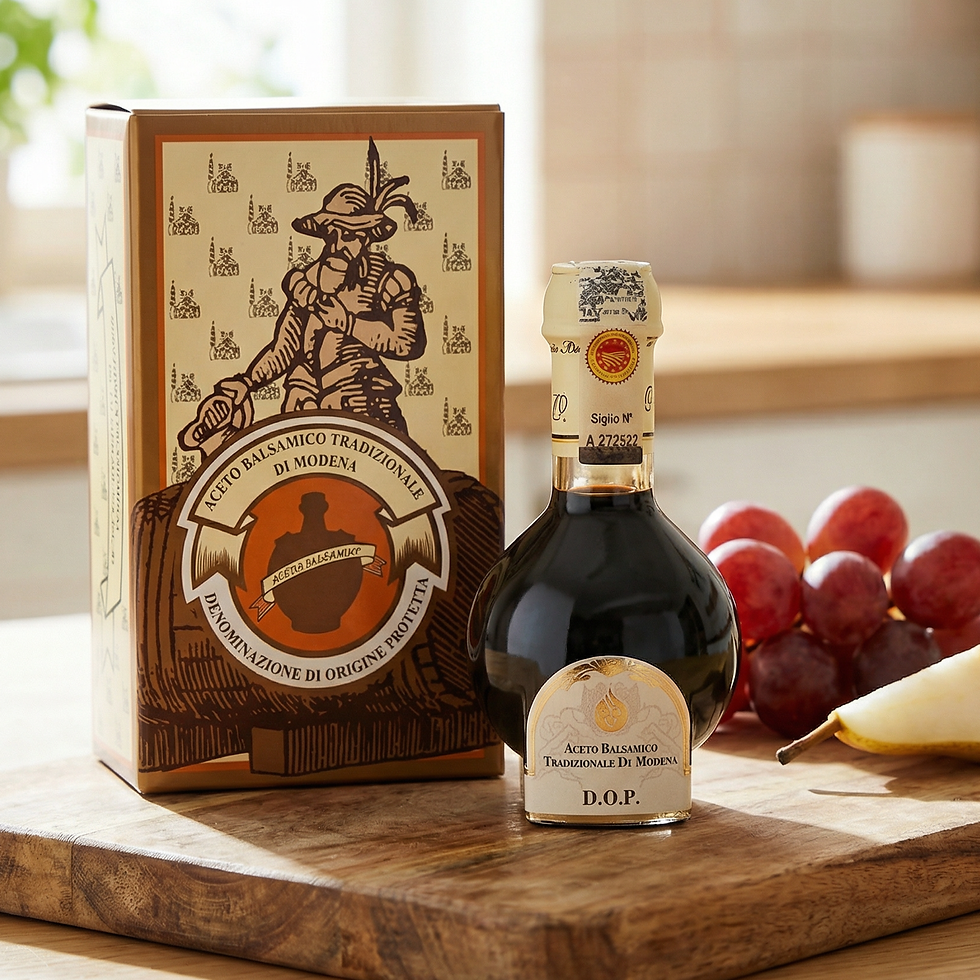
Tasting pack of Traditional Balsamic Vinegar of Modena DOP over 25 years of barrel aging
"Protection Consortium" package.
Product Quantity: 100 ml.
Product in glass ampoule inside a box complete with dispenser and descriptive leaflet
Packaging Tasting Traditional Balsamic Vinegar of Modena DOP - "Extravecchio"
The Traditional Balsamic Vinegar of Modena PDO is a condiment made from the musts of the typical grapes of the province of Modena. It aged at least 12 years and in the case of the Extra Vecchio type, at least 25 years.
In this case we are in the Extravecchio type, bottled by the Protection Consortium.
The production area of Traditional Balsamic Vinegar of Modena PDO is within the entire territory of the province of Modena, in the Emilia-Romagna region.
The Traditional Balsamic Vinegar of Modena PDO is obtained exclusively from the grape musts coming from the vineyards of Lambrusco, Ancellotta, Trebbiano, Sauvignon, Sgavetta, Berzemino, Occhio di Gatto and other minor vines registered with the PDO in the province of Modena. After pressing, before being cooked, the fresh musts can be decanted and refrigerated as long as the watery part does not freeze. Cooking takes place over direct heat in an open-air boiler at temperatures around 80 °C. The product thus obtained (cooked must) is grafted with old vinegar (mother graft) and subjected to a process of fermentation, acetification and aging. Everything takes place in a battery of barrels for a minimum time of 12 years, following the practice of annual decanting which consists in bringing each barrel back to level, starting from the smallest, with the necessary quantity of vinegar, taking it from the barrel previous battery; the last barrel, the largest (mother barrel) is instead leveled with acetified must.
The adjective "balsamic" is reported in documents dating back to the time of the Duchy of Este, but the first testimony that speaks of this very special vinegar is the " Vita Mathildis", a poem by the monk Donizone of Canossa in the 11th century. The production could be traced back to the times of the Roman Empire, when it was customary to cook the grape must to obtain a thick condiment that was no longer fermentable. In fact, Columella, a Roman scholar of agriculture , reported in the 1st century AD how the must cooked in the area had a tendency to ferment and therefore to become acidic (solet acescere). The battery process then developed in the vinegar factories of the most aristocratic families, in which their own vinegar was considered unique and inimitable, therefore a source of pride. The oldest technical evidence is the manuscript of Giorgio Gallesio (Travel Journals , 1839) and the letters of the lawyer Francesco Aggazzotti of 1862.
Characteristics
The Traditional Balsamic Vinegar of Modena PDO is characterized by an uncommon complexity which is highlighted by great olfactory intensity, harmony to the taste and long persistence on the aftertaste. It is dark brown, sweet and sour.
Pairings
Thanks to its versatility, this product can be used in the kitchen to prepare countless recipes, from the simplest and simplest to the most refined and elaborate. It finds its maximum expression in the encounter with fresh and boiled vegetables, with risottos, with meat and fish dishes, ice cream and fruit (especially strawberries). Excellent with meat carpaccio, beef and pork fillets, boiled and roasted meats. It can also be tasted on its own, on a ceramic or plastic spoon (never metal because it alters the flavour) at the end of a meal to cleanse the palate.
Store at room temperature in a cool, dry place away from heat sources.









Reviews